
This qualitative research used document analysis, field surveys and observations. It outlines urban development in China, with a focus on the Cold War, between 1949 and 1991. The research identifies ramifications for contemporary Chinese cities and other former communist countries.
Chinese civilization has endured thousands of years. For centuries, Confucian and Taoist philosophies influenced Chinese architecture and urbanism. Traditional Chinese imperial cities were highly organized, well managed and carefully planned. All of them were walled, in a regular and consistent pattern. The great gates were located at each of the cardinal points of the compass, from which broad, straight avenues were laid out intersecting in the middle of the city. The centre of the city contained a drum tower, a plaza, a cluster of official buildings, and a Confucian temple. Traditional Chinese urban form remained anchored in the ancient principles designed to find harmony between the natural world and the constructs of humankind. Feng Shui is an ancient Chinese art of arranging buildings, objects, and space in an environment to achieve harmony and balance. The fact that the layout of the city is a representation of the cosmos underpins the fact that the ground floor layout is fundamental to the concept of a Chinese city. Landscape morphology is also a key aspect of Feng Shui. Best urban landscapes tend to be open to the south and bounded by a mountain to the north. Water is also regarded as an important element of Feng Shui and its flowing stream brings benefits to all the residents and scares away evil forces.
In 1860, after the two Opium Wars, western influence on the coastal part of the Chinese mainland increased. The Chinese Imperial government signed treaties with the western colonial powers including Great Britain and France. These Treaty Port cities granted extraterritorial rights to Europeans and Americans in Chinese coastal cities allowing them to inhabit and operate without being subject to Chinese law. The Treaty Port era had a significant impact on the physical, social, cultural, and economic environments of Chinese coastal cities including Shanghai, Qingdao, Tianjin, Xiamen, Fuzhou, and Guangzhou (former Canton). As a result of the Treaty Port major cities located along the eastern coast had a different urban character from other cities located inland. The different urban characteristics were reflected in the dominance of western-style architecture, presence of European cultural values and social interaction patterns. Examples of western influence architecture and urban landscapes are shown in Figure 1.
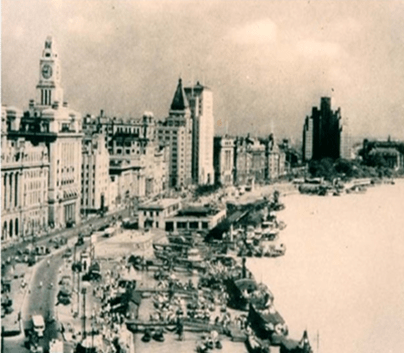
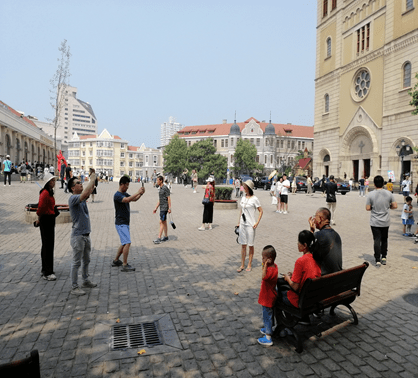
Figure 1: The western influences on architecture and urban landscapes in Shanghai (top) and Qingdao, Shandong Province (bottom). Sources: ResearchGate (top) and Authors (bottom).
The 1949 revolution ushered in many changes. The new communist regime radically transformed Chinese society, its economy and built environments. Until 1979, Chinese Maoist city elements inspired urban transformation. However, from 1979 capitalist influences, accentuated by unprecedented rural-urban migration, shifted the mode of urbanisation towards commercial property-led development. An unfortunate side effect of this recent phase of Chinese urbanisation was the wanton destruction of traditional hutongs or alleys lined with traditional courtyard residences.
In recent times, exposure to climate change impacts, including drought and heatwaves, has tempered the worst excesses of ill-considered commercial development practices. Arguably, more sustainable developments now incorporate fruitful aspects of ancient Confucian, Taoist, or Feng Shui wisdom. An example of a city sited according to the principles of Feng Shui is shown in Figure 2.
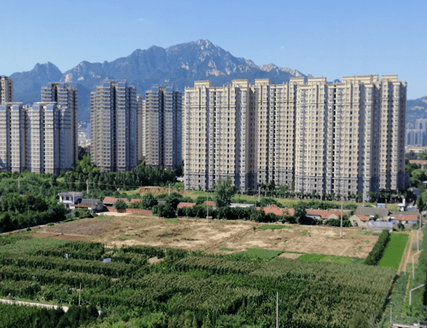
Figure 2: The city of Tai’an, Shandong Province located in front of Mt. Ta’ian – an example of Feng Shui principles. Source: Authors
The wider implications of this research for students are that one must be very sceptical of ‘group think’ or surreptitious indoctrination. Freedom of thought must be nurtured (rather than repressed) and new projects, initiatives, or strategies for change must be carefully considered from multi-disciplinary perspective.
Dr. Simon Huston
Kozlowski, M., Huston, S. & Mohd Yuof, Y., 25 Jun 2024, The Cold War Re-called : 21st Century Perceptions of the Worldwide Geopolitical Tension. Suchoples , J., James, S. & Hanka, H. (eds.). Lausanne: Peter Lang AG, p. 91-113 22 p.